

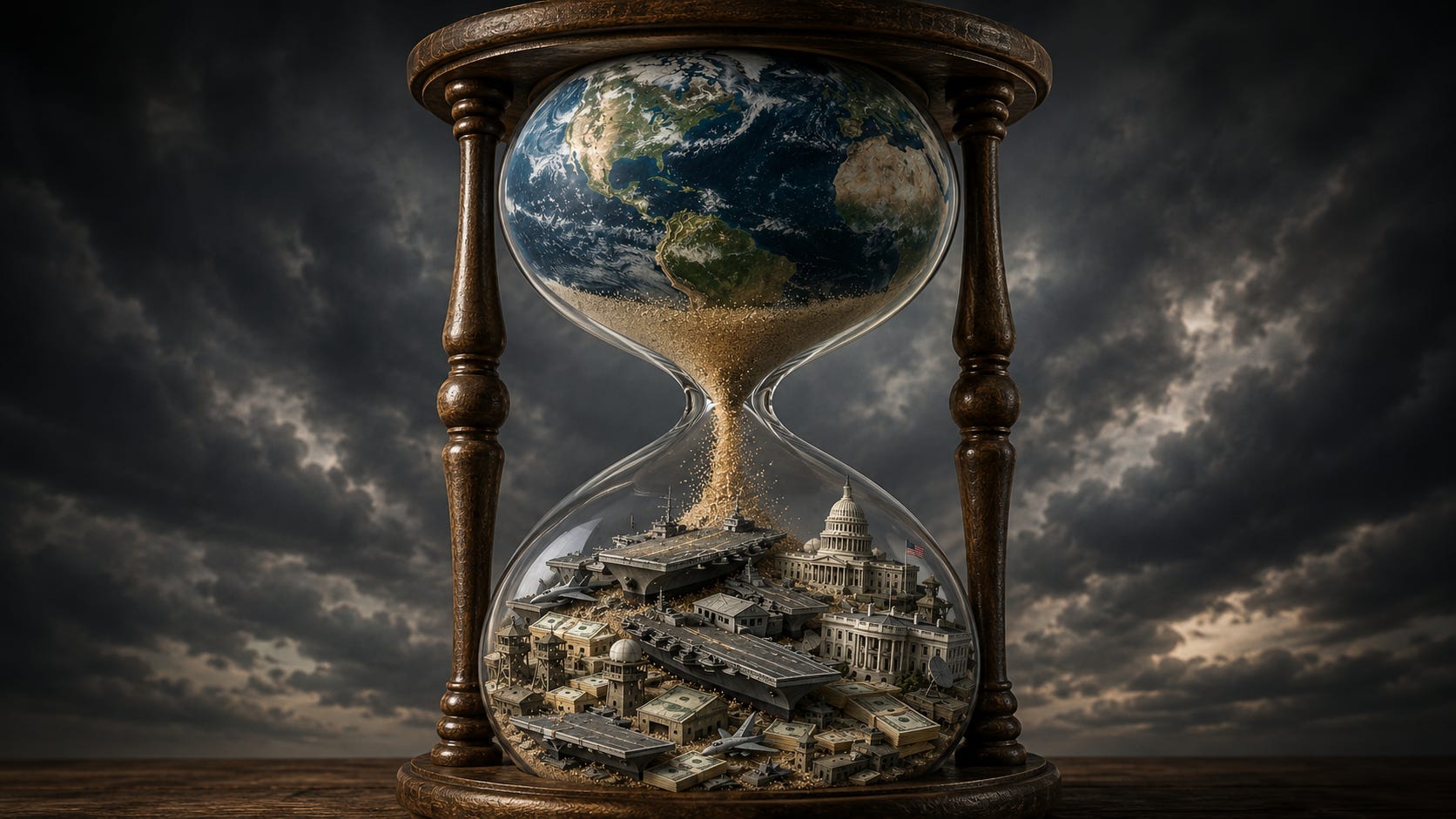
Every empire has a deadline. Once a nation chooses the path of empire, it begins a countdown clock. It’s a nation’s Faustian bargain: The temptation of power and expanse comes with a hefty price tag. It’s only a matter of when and how an empire ends, not if.
In the very first article of this publication, I introduced what I call the Hobbesian Dilemma, named for Thomas Hobbes’ concept of centralizing power as outlined in The Leviathan. Simply put, it’s this:
Governments must grow and centralize increasing amounts of power to counter both internal and external threats — only to grow so large and inefficient they eventually collapse under their own weight after mismanaging those same threats.
An empire grows by definition and will expand until constraints prevent further growth. Its maximum territorial extension is its high water mark. A failure to continue to grow — directly, via proxy, or via alliances — is what marks the beginning of a hegemonic project’s decline.
Indicators are flashing red that the United States is past its zenith as an empire and is on the way down. Crumbling faith in national institutions, a series of botched unnecessary wars, and debt-to-GDP ratios not seen outside of wartime are just a few examples of those indicators.
The pace and depth of the decline are widely debated, but the direction looks increasingly clear — downward. So what happened?
Simple: America got wrapped up in playing the Great Game of empire-building. Like many great powers before it, it thought itself unique in history. In the process, it has squandered immense wealth, soft power, and the loyalty of many of its citizens.
The term “The Great Game” itself refers to the British and Russian Empires squabbling over central Asia in the mid-1800s. Both empires were gone within a century.
Many empires have existed, and all have failed eventually. So far, at least.
I expect the United States to follow the same path, though in its own idiom, of course. The US is structured uniquely as an empire. Rather than direct territorial gains, it relies on proxies, financial power, and allies to expand its sphere of influence. Even if it were to shed all its alliances, overseas bases, and proxies, it would remain formidable. Just not an empire.
Just how the American Empire began to decline will be studied for centuries to come. But, for fun, I figure we can get a quick start here by examining the following six reasons.
1. Built for the Wrong Century
The United States rose to power in the century that represented the greatest dynamism and growth in human history. Humanity went from the horse and buggy at the beginning of the century to space flight by mid-century. European global hegemony was shattered. And the world’s population skyrocketed from around 1.6 billion to more than 6 billion by the century’s end.
America was perfectly built for that world.
Rapid technological breakthroughs were common, while the country maintained a high-trust and relatively cohesive population. Energy was cheap, geography was easily defensible, and endless growth seemed inevitable. National mythology was overwhelmingly optimistic.
The cruel joke is that every trait that made America successful in the rising 20th century accelerates its decline in the 21st. Openness became a vulnerability, with mass immigration diluting cultural values. Individualism became atomization as seen in social media algorithm silos. Constitutional gridlock that once prevented government overreach now produces strategic paralysis and, de facto, delegates far too much power to the executive branch.
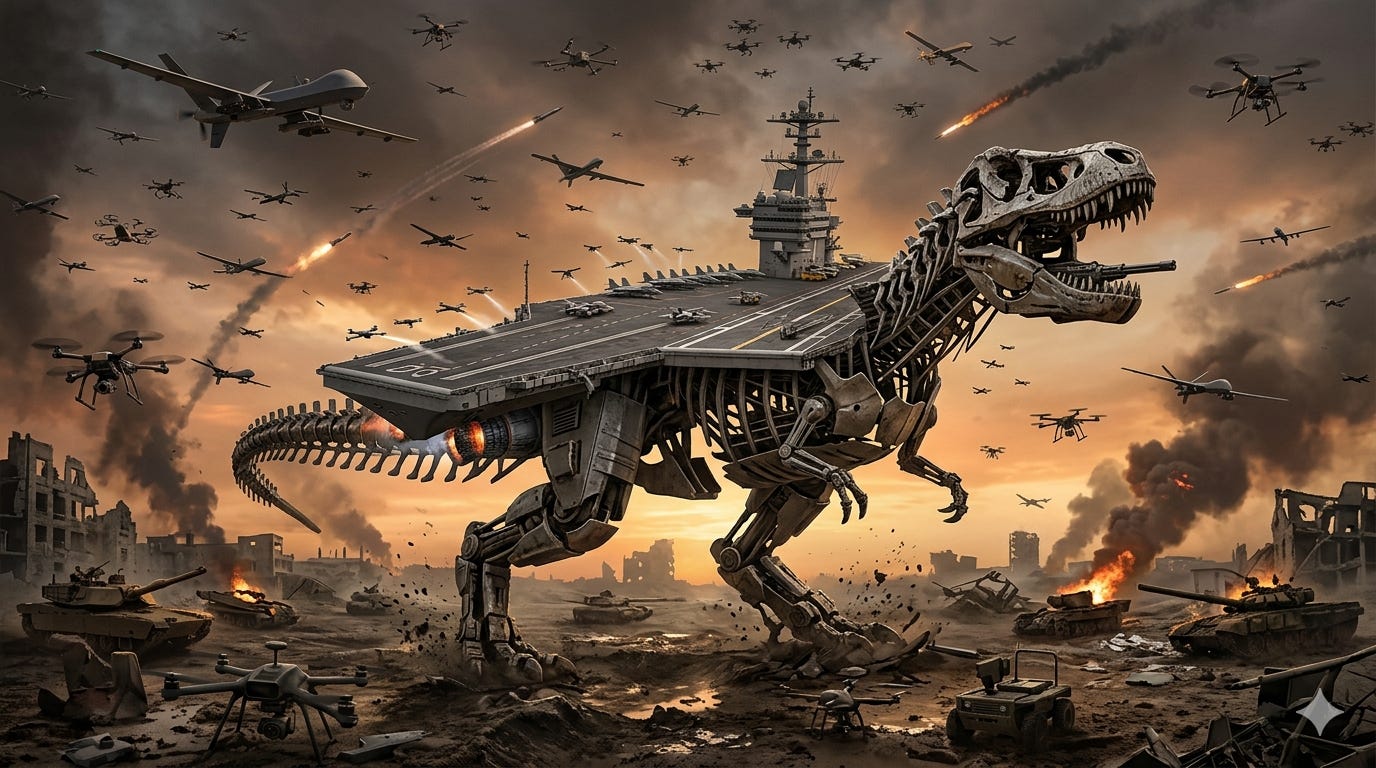
A perfect symbol of this mismatch is the aircraft carrier. Once the apex predator of the 20th century, these $13 billion floating cities sail as vulnerable dinosaurs — readily damaged or sunk by 21st-century weapons. It was no surprise when the carrier George H.W. Bush went around the Horn of Africa rather than risk the Red Sea and face a barrage of missiles or cheap drones.
This is 20th-century hardware trying to police a 21st-century world. These relics remain the backbone of a wildly overextended navy — the inevitable result of a state grown too big and too centralized to pivot.
2. Overextension
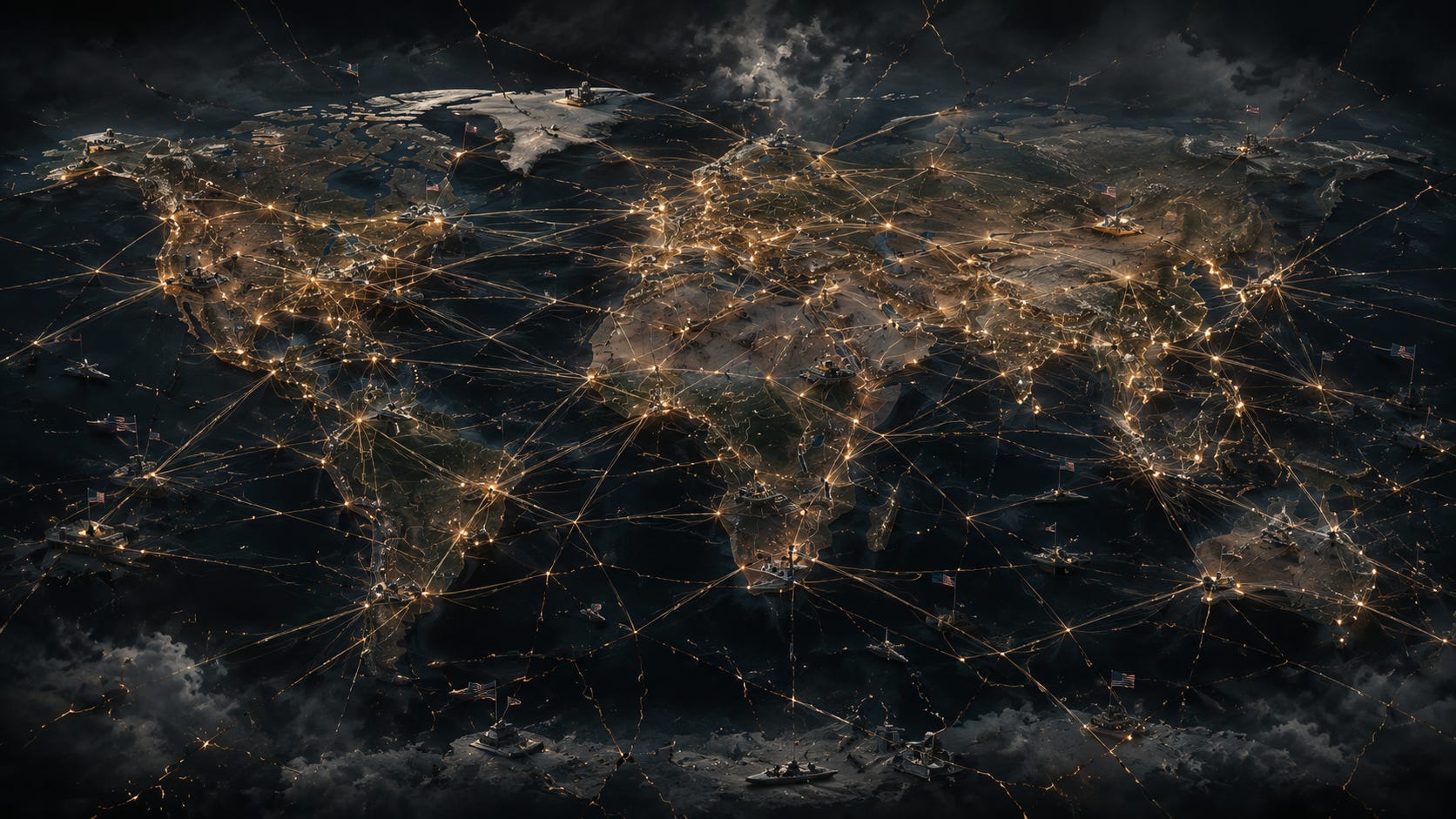
The vast network of US military bases wasn’t built for today’s multipolar world. Rather, it was built to contain the Soviet Union and its goal of worldwide communism. But this Cold War containment machine was never dismantled despite the mission ending in 1991.
Instead, that network of more than 750 bases in over 80 countries now acts as a series of tripwires that entangles the US in countless shaky alliances, uses its soldiers as bait, and costs an ungodly amount of money.
And it’s not even working. Allies that host American military bases increasingly find themselves targets instead of protected. The Gulf Arab states are a loud canary in this coal mine, with their critical infrastructure in the crosshairs as the result of an unnecessary war.
Worse, America can no longer sustain its sprawling commitments. To support operations in the Middle East, the US has cannibalized ammunition, precision munitions, and air defense systems from East Asian stockpiles. Pacific commanders watched reserves meant for a Taiwan or Korean contingency dwindle, while American munitions manufacturing remains painfully slow. Even a few years ago, any potential American defense of Taiwan against China looked challenging at best. Now it looks downright impossible.
A state grown too big and centralized is now stretched too thin to defend its priorities effectively. Yet the real breaking point may not be resources, but resolve.
3. No Tolerance for Loss

The Death of Paulus Aemilius at the Battle of Cannae by John Trumbull
The Roman Republic lost roughly 60,000 men killed in a day at Cannae. It went on to win that war (Second Punic War) and wipe Carthage from the face of the earth two generations later. An empire has to be able to take a hit as well as dish them out.
The US lost some 58,000 men killed in Vietnam over a period of years despite killing millions of Vietnamese, and it entirely screwed up the national psyche. Americans wouldn’t tolerate the losses and have dealt with what’s called “Vietnam Syndrome,” or casualty-aversion in its military, ever since.
The astute among you will point out a key difference: Rome was under existential threat at the time, but the US was not. This is mostly true, and is directly related to the key reason the US hasn’t had any real tolerance for loss since the Civil War: The US has been in no existential wars in the last 160 years. The concept itself is foreign. Contrast this with Russia, which has fought repeated existential wars in its history, and is currently engaged in a high-attrition war without showing signs of flagging.
This casualty aversion shapes strategy. It forces reliance on proxies, drones, and standoff weapons — tools that signal weakness as much as strength. Adversaries take note. As Ho Chi Minh put it, “You will kill ten of us, we will kill ten of you, but you will tire of it first.” He was right. Everyone contesting American power now bakes that reluctance into their strategy.
An empire that can’t tolerate blood can’t maintain its frontiers.
I don’t expect Americans to grow any stomach for great losses anytime soon, as external existential threats are distant and not immediately threatening. Any real threat to the country will almost certainly come from inside.
4. Trouble at Home
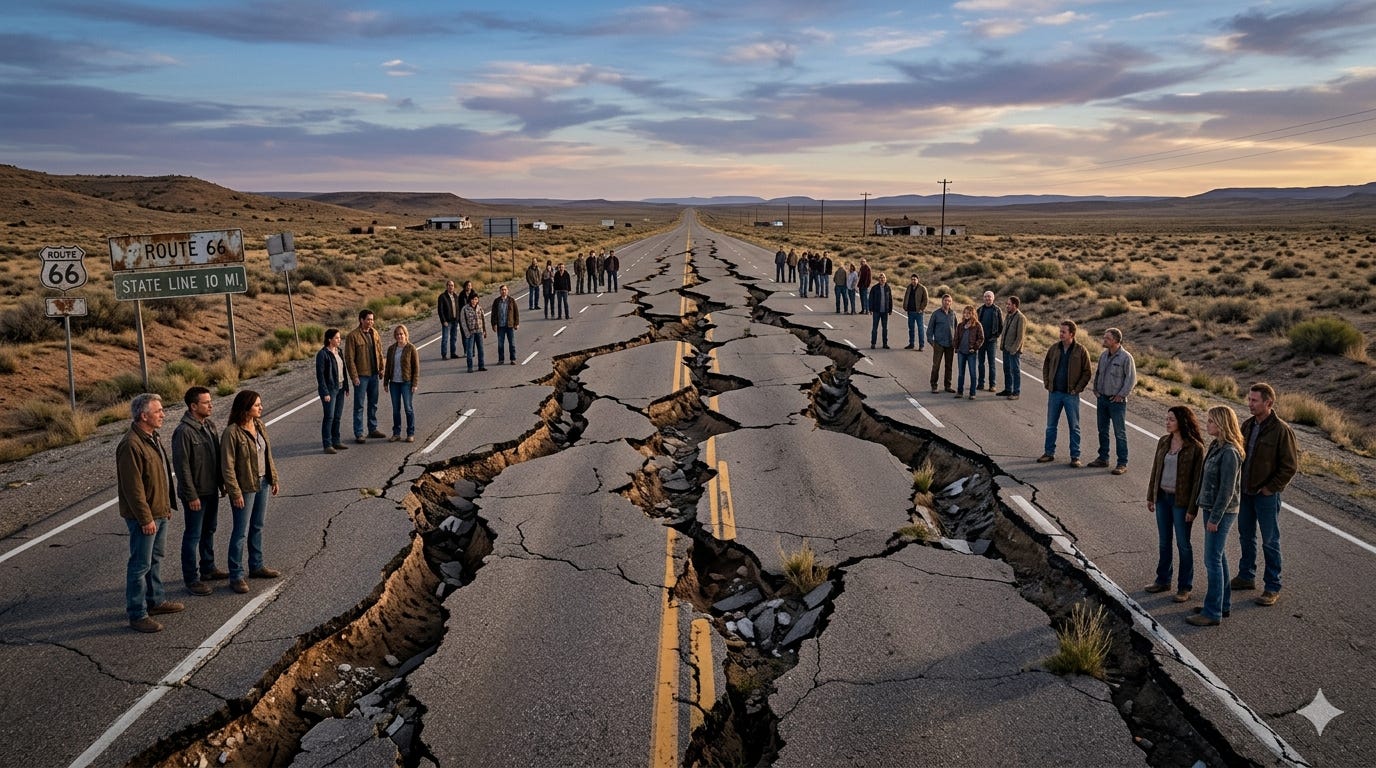
To say that politics in the US are contentious is an understatement. It’s turned into a distraction that’s a waste of a country’s most critical natural resource: its citizens’ attention and energy. When tribal squabbles replace future-building, the backbone of the nation develops scoliosis.
I’ve written before that the irreconcilable differences between Americans will lead to further violence, which has already begun. The currents run deeper than surface-level partisanship.
Interpersonal relationships are increasingly strained by politics: Some 37% of Americans have had a “political breakup”, whether with friends, family members, or romantic partners. If you’re curious, those on the left do the majority of the breaking-up.
The trouble goes beyond politics. Law enforcement across the country appears to be gearing up for a new type of unrest, designating “Anti-tech extremism” an emerging threat to the country. Data centers — the physical backbone of the booming AI economy — are becoming symbols of elite priorities over ordinary citizens’ economic futures. When your own population views server farms as legitimate targets, legitimacy itself is cracking. So who’s going to lob the first Molotov cocktail? The FBI is definitely asking this question.
This domestic fragility is painted on the canvas of a shaky economy and stagnating living standards for many. A divided, low-trust society that can’t agree on basic reality is poorly equipped to sustain the costs, sacrifices, or shared myths that an empire demands. An empire this divided at home will struggle to project power abroad. Internal disorder ultimately dictates the outer limits of power.
So, too, does money.
5. Wartime Spending during Peace
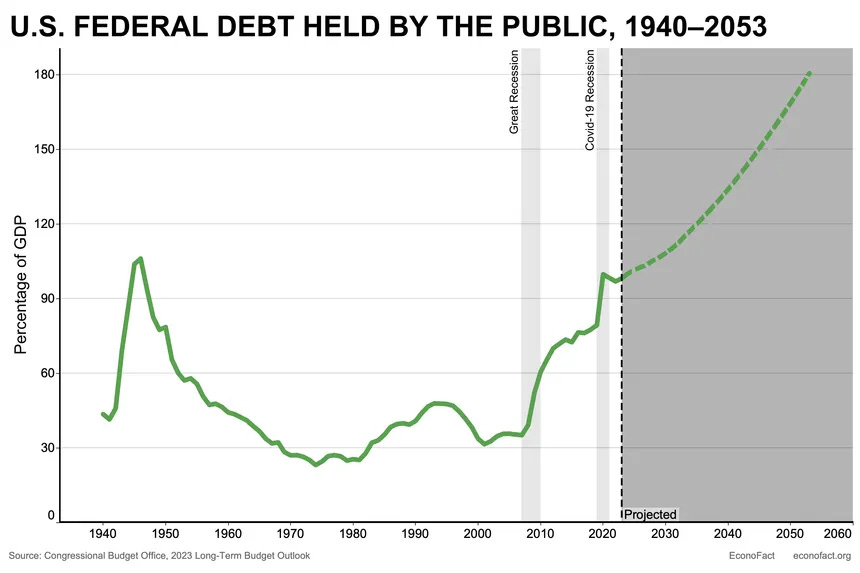
Anybody who’s played a strategy game knows you can’t maintain wartime spending forever. The resources spent on maintaining an enormous standing army, global bases, and endless commitments inevitably lead to massive misspending and distortion. A nation at peace should be investing in its own future — infrastructure, education, research, and productive capacity.
The old Roman maxim si vis pacem, para bellum (“if you want peace, prepare for war”) does not suggest funding that preparation through endless debt. But the US debt-to-GDP ratio is now higher than it was at the height of the Second World War, with no end in sight. Interest payments alone are beginning to crowd out other spending, and this trend will only accelerate, creating a vicious cycle only sustainable through monetary manipulation.
This is the Hobbesian Dilemma in fiscal form. Centralized power has grown the state to meet external threats, but the resulting bloat and addiction, ranging far beyond military spending, have become threats themselves — especially to the dollar’s reserve status.
Machiavelli noted the sinews of war are not gold, but good soldiers. There is indeed wisdom in maintaining institutional knowledge in the military during peacetime. But what makes a good soldier? Beyond training and equipment, it’s the willingness to kill and die for the cause.
Who wants to fight — and who wants to send their children to fight — for a government that shows little loyalty to its own citizens?
6. Ideological Capture

US foreign policy — and, increasingly, domestic policy — has been captured by a constellation of ideologies and entrenched interests that diverge from the clear national interests of American citizens. What began as institutions to combat the Great Depression, fight World War II, and contain communism during the Cold War evolved into a self-sustaining architecture that metastasized into a life-threatening tumor.
A toxic combination of executive branch agencies, weapons manufacturers, financial and tech interests, ideological NGOs, and powerful foreign lobbies form this architecture that aims to steer the ship of state.
The machinery of containment never demobilized after 1991. Instead, it was repurposed. Networks originally designed to counter Soviet influence became instruments for regime change and perpetual global engagement. Rather than declare victory and collect a peace dividend, the US went on a global offensive expanding the empire under the guise of “democracy” and “human rights,” flanked by allies and NGOs hoping to sup at the imperial table.
One of the most visible and costly examples of ideological capture is the influence of Israel and the pro-Israel lobby, where Israeli strategic priorities often eclipse American ones — most glaringly in the current war with Iran. Americans are increasingly resentful of foreign entanglements, which make them feel used. Polling shows the nation’s youth, in particular, are growing sharply dissatisfied with this relationship. This cannot last forever.
Similar dynamics operate elsewhere. Financial institutions protect dollar hegemony at the expense of American workers. Big Tech shapes narratives and censors dissent while pursuing its own power — even openly threatening citizens’ economic future. Defense contractors grow rich off perpetual conflict and instability. War is profitable — which is precisely why empires so often begin.
The pattern is clear across administrations. Every president since the end of the Cold War has expanded the scope of US engagements abroad despite campaigning on restraint. Each time, the pledges of retrenchment gave way to the same entrenched forces.
In short, the common thread is this: A governing class captured by grand ideologies and special interests, even as public support erodes.
When ideology and institutional capture replace cold realism and national interest, the empire loses its ability to adapt or retrench. It piles on commitments the public no longer supports and the treasury can no longer sustain. The centralized power structure, built to protect the nation, increasingly serves everyone except the nation itself.
If You Can Keep It

As the US approaches its 250th birthday, the irony is impossible to ignore. The republic that began as a rebellion against empire is now struggling under the weight of one.
George Washington’s Farewell Address explicitly warned against “permanent alliances” and “passionate attachments” to foreign nations. Dwight Eisenhower used his own farewell address to caution against the “unwarranted influence” of the military-industrial complex. Both feared the republic would be corrupted or hijacked and become a twisted version of itself.
We discarded their advice. The Hobbesian machine we built to protect the nation — and its allies — has grown too large, too captured, and too inflexible to serve the nation that created it. Centralized power, meant to counter threats, now creates them.
What began as a republic only occasionally dabbling in empire has become an empire that only occasionally remembers it was a republic.
History is not sentimental. It collects on Faustian bargains whether we acknowledge them or not. The high-water mark has passed. The question is not whether the American Empire will follow the path of all those that came before it, but how steep and disorderly the descent will be. Empires rarely reform themselves. Republics, at least in theory, still can — but only if they remember what they are.
The US still has plenty of advantages. It has the most enviable geography in the world, a large and highly skilled population, massive natural resources, and a culture that prioritizes growth and development. Those are real assets that can carry the country far into the future — as long as they’re not sacrificed on the altar of empire.
Benjamin Franklin’s warning — “A republic, if you can keep it” — now carries a darker echo. We built a republic. We turned it into an empire. The question is now whether we can keep either.
A different view of the U.S. revolution is that a colonial ruling class wanted to build a continental empire without interference from Britain, which was restricting migration across the Appalachians. Land speculators such as Washington could not abide that. Then the U.S. went on the build that empire, conquering native tribes in the way. When that was done it went overseas with the Spanish-American War. The U.S. has been an empire from the start. So where the country is at is not ironic, but seeded in its roots. . Historian William Appleman Williams has written about our “Empire As a Way of Life.” The fundamental U.S. drive is expansion. But the empire seems to have hit its limits as you document here. I approach that from a slightly different angle here. https://theraven.substack.com/p/on-this-memorial-day-nemesis-stalks
"The vast network of US military bases wasn’t built for today’s multipolar world. Rather, it was built to contain the Soviet Union and its goal of worldwide communism." I don't think this is true. The US has crushed any nationalist, sovereignist movement that could reach in order to bring freedom and unrestrained liberty for the wall street capital. Everyone else, includingthe Soviets, wonted to be left alone to mind their own business... That is Iran's or Cuba's or Venezuela's sin today...