

No book gets weaponized more often than 1984 when we complain about surveillance, propaganda, or power. But beneath the memes lies a sharper question: How close are we, really, to the actual geopolitics of Orwell’s nightmare?
Let’s lay out the foundation. In the book, three super-blocs — Oceania, Eurasia, and Eastasia dominate their spheres. Oceania covers the Americas, the UK, southern Africa, and Australia and New Zealand. Eurasia spans from Lisbon to the Pacific. Eastasia mostly includes China and its near neighbors.
A fourth zone, stretching from Morocco to Indonesia, is one of permanent, managed, and carefully orchestrated war to get rid of excess production. This system keeps the proles down and creates constantly-changing enemies for leaders to direct and control their peoples’ ire. A cabal called the High controlling all three organizes these wars. A lot of this is left intentionally vague, but here’s a map for reference. The grey zone is the contested zone:
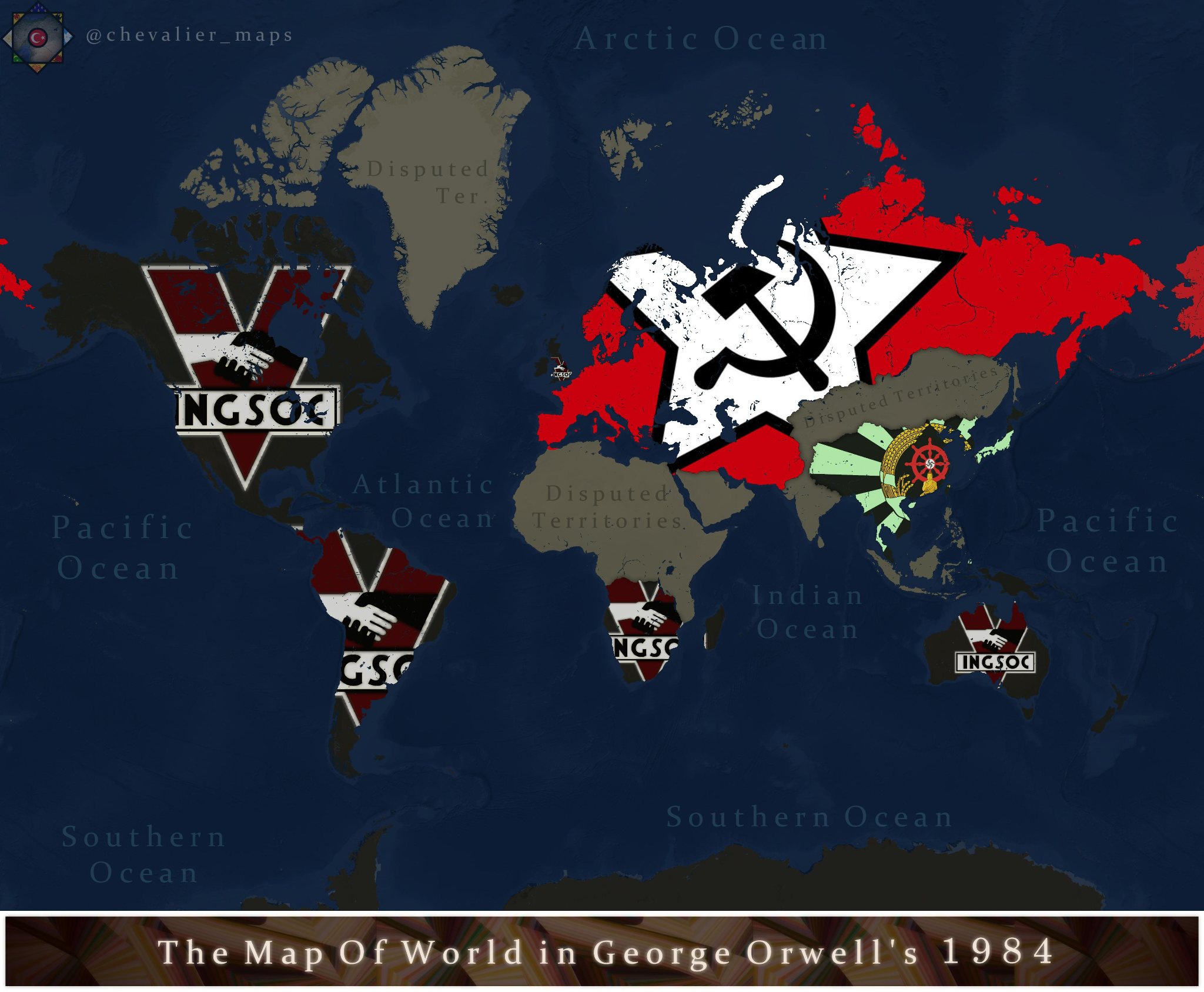
This rigid, tri-bloc system didn’t emerge from nowhere. Orwell implies it was forged in the fires of a devastating nuclear war that upended the old world order. This is what led to the system in the book.
So, before we dive in, let’s answer emphatically: No, we are not currently living in the geopolitics of 1984.
But we’re not that far off. Rather, it looks more like the time before the setting of the book. So what would it take for us to get there?
The Three Blocs are Already Here (sort of)
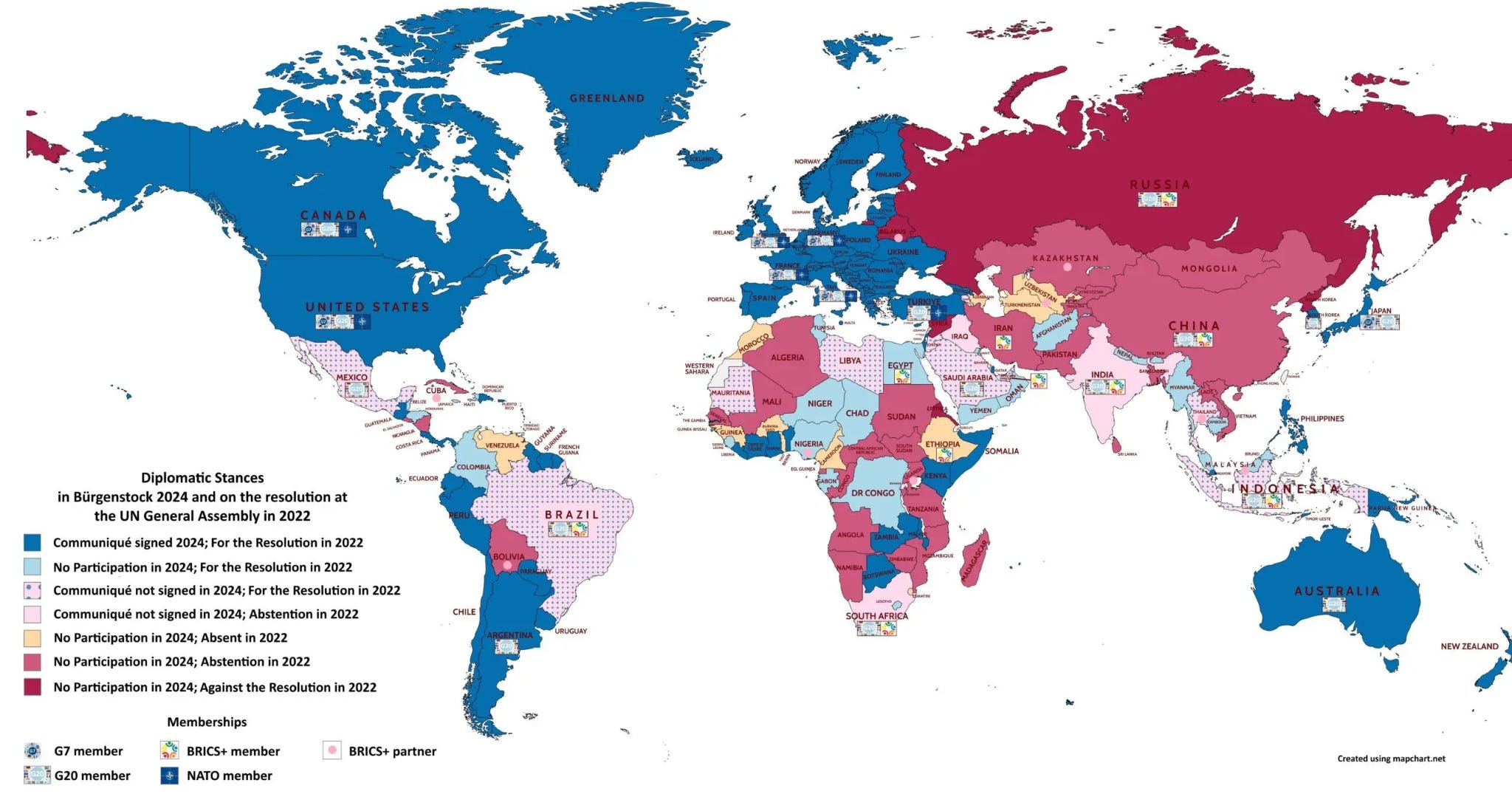
The Blocs of Oceania, Eurasia, and Eastasia already exist. Sort of — basically in their infancy. These are the US-led NATO nations, Russia, and China. Imagine these as seed crystals of potential future super-blocs like Orwell described.
While right now it might look like there’s a multipolar world, with the US and EU helping Ukraine and Taiwan to fight Russia and China aggressing their neighbors, there are really only three major power centers. Europe is an old man leaning on a cane but promising rearmament, South America is directionless though not without potential, and the Anglo world is united behind the United States whether they like it or not.
Eurasia and Eastasia are certainly not formed yet, as the EU is fully committed to supporting Ukraine. Russia and China, along with Iran, have aligned with each other to combat what they see as Western aggression, and are key players in the BRICS super-alliance. So, they’re probably not fighting anytime soon. Indonesia has recently joined BRICS, as well, adding another regional heavyweight to the bloc. Brazil is the “B” in BRICS so its influence in South America will be huge. The question with BRICS is if it will last under bureaucratic, military, or economic pressure.
One major question that will arise, and which I doubt Orwell foresaw (I don’t blame him) is the nuclear weapon proliferation that has made India, Pakistan, Israel, and North Korea all wildcards. India, hamstrung by its infrastructure, is not yet a superpower, and it has largely played neutral so far, despite joining BRICS (it’s the I).
But the perpetual wars? The fighting in parts of the disputed zone? They’re all there. Destroying the foundations of Libya, Syria, Iraq, Yemen, and so on, fit perfectly into the narrative. Little Britain, having lost its empire, looks to its former colony for protection. Those parts fit.
So, right now, it may be easy to look at the world via a West-vs-BRICS lens. Alliances of convenience are exactly that — convenient — so I doubt BRICS would last under intense pressure. But the three seed crystals of blocs? They’re still very much there and aren’t going anywhere.
Perpetual War, 21st-Century Edition
We’ve all lived through decades of perpetual war. The US has been at war for much of my lifetime. Proxy conflicts are continuing and spreading. And this trend doesn’t seem to be stopping.
A perfect example is America’s war in Afghanistan. Twenty years, trillions spent, and the surplus vanished into the military machine. Sound familiar?
If you’re cynical like me, you probably believe it didn’t exist for some noble goal, but rather to redirect resources to state-friendly organizations like weapons manufacturers and banks. The current proxy wars, like Ukraine, exist not to be won but to bleed the opponent of resources. Taiwan hasn’t popped off yet (and we should all pray it doesn’t) but it could at any moment. The new frontiers seek control of resources like Venezuela’s oil and Africa’s mineral resources like cobalt. Israel’s brutalization of Gaza has set a spark in the Middle East that may find its powder keg.
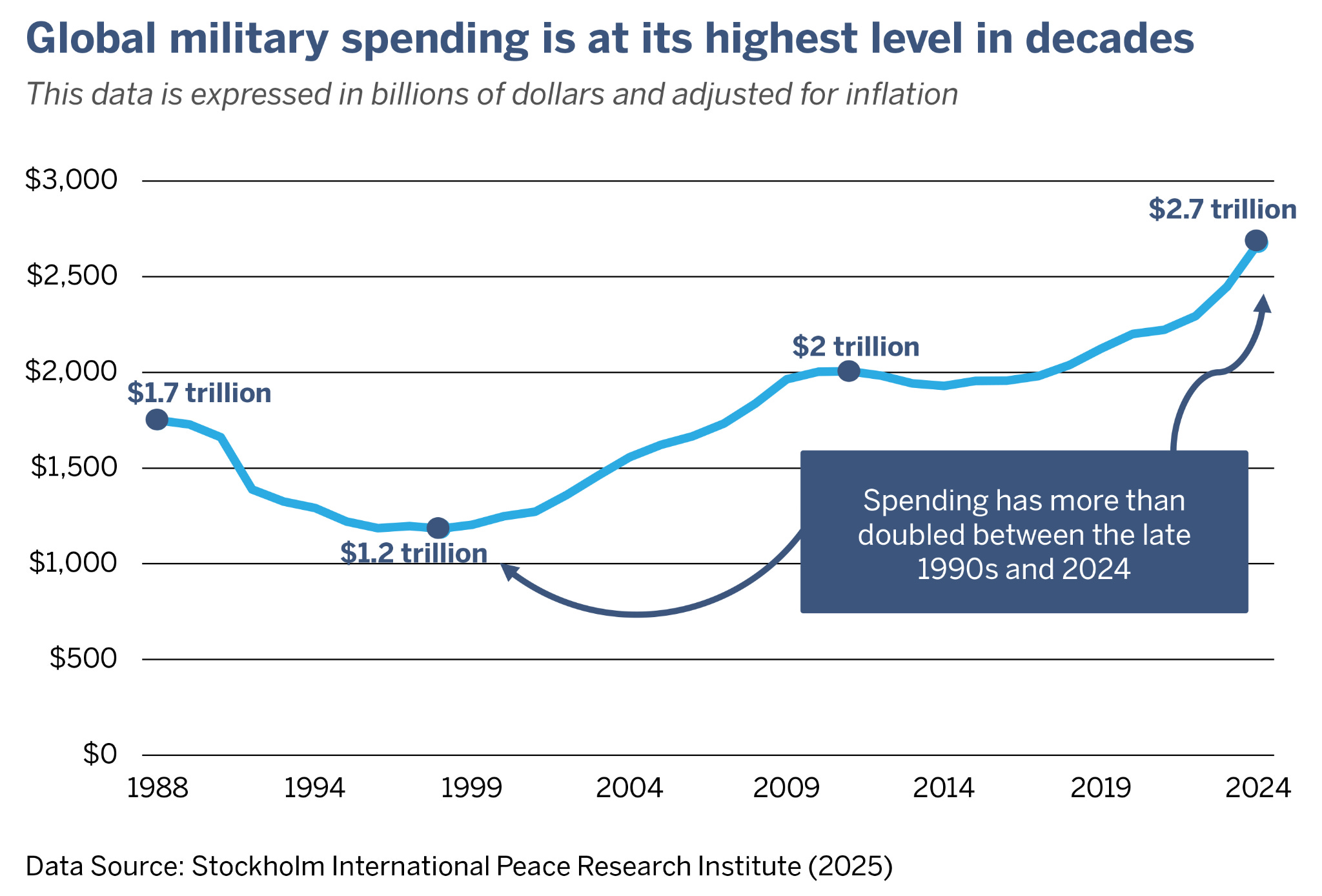
The problem: Any of these conflicts could escalate and get much hotter at any point. It only takes a few mistakes to get to something nasty. Global military spending hit a record high of some $2.7 trillion in 2024, growing nearly 10% over 2023 figures — the largest year-on-year jump since the Cold War. Europe promises more — the money is the message. So, how might we slide from today’s chaos into Orwell’s engineered stalemate?
What Would It Take to Get to the Geopolitics of 1984?
The following will be a fun thought experiment of a terrifyingly plausible checklist that could lead us to the real geopolitics of 1984.
Escalation in Ukraine, Taiwan, or elsewhere spirals into tactical nuclear use, devastating Europe and parts of Asia while sparing the industrial cores of North America, Russia, and China. Germany’s chancellor Merz has recently trotted out the idea of forced conscription, so it appears the EU is hell-bent on continuing the war in Ukraine. In this scenario, Russia ends up dominating Europe, or they merge, much to Britain’s horror. This leads to Airstrip One (Britain in 1984).
A collapse or forced absorption of hedging powers like South American countries, or India and Pakistan. Imagine India splitting into many countries (which it historically was), or Brazil’s government losing legitimacy, or Indonesia splitting into different countries. We’d need a major economic disruption to have that happen, but that’s absolutely in the cards.
The sudden death of the dollar would cut the legs out from American economic and military hegemony, forcing it to retreat to its own sphere of influence, i.e. the Western Hemisphere and the Anglosphere. Imagine rationing, a breakdown of international trade routes (currently guaranteed by the US Navy) and a greater focus on internal trade.
A catastrophic cyber or solar event that kills the open internet, leading to permanent national intranets (should people manage to rebuild them).
Open coordination between the three remaining elite circles (an actual “High” like the one Orwell described).
Normalized 4-year “Hate Cycles” with seamless alliance flips and memory-holing. This has already happened, too. We were supposed to hate Saddam Hussein, then Slobodan Milosevic, then Osama bin Laden, then Vladimir Putin, then Xi, or Netanyahu…you get the point.
Ubiquitous, flawless, cheap deepfakes, with no trusted primary evidence left. We are close to here already.
One full generation, born after the major war, that has no memory of anything other than CBDCs or algorithmic loyalty systems.
Wrongthink and the New Ministry of Truth

Every emerging bloc runs its own memory hole. In the US, government-pressure campaigns on platforms and algorithmic shadowbanning quietly reshape what millions see while digital silos create parallel realities people live in. This creates a chilling effect on discourse where people are afraid to speak their own minds even in private conversations.
It’s not just a chilling effect, either. The UK has locked up more people for wrongthink online than any other Western democracy.
That telescreen in 1984? It’s a child’s toy compared to the phone in your pocket. The telescreen watched you, sure, but today’s pocket supercomputers know you better than you know yourself. Orwell never imagined the kind of power algorithmic nudging could have on populations, which could well lead to civil conflicts in many countries, or how data could be collected in such vast amounts and analyzed by AI systems. We all know we’re being spied on all the time and, in a word, it’s creepy. The Stasi would be jealous.
Censorship is rife everywhere, and deepfakes will become ever more common. Covid broke many people’s brains and tribalism regarding all kinds of political opinions keeps people divided in Western countries, weakening them. History has been rewritten: Statues torn down, former heroes decried as racists or whatever. Censorship is by no means limited to Western countries: Russia, China, and many other countries each have their own version of wrongthink, and they’ll enforce it brutally or softly depending on the person.
Orwell imagined state propaganda dominating everything. He never foresaw private platforms, armed with AI, doing the job more efficiently — and voluntarily accepted by its users, doped up on pharmaceuticals or booze or weed. That’s more Huxley territory.
Add to that mass migration of non-assimilable peoples as well as irreconcilable political differences and you’ve got a recipe for disaster that’s ready to serve as a poisoned cocktail.
This control sustains and divides the political blocs, further crystallizing the current seed crystals that may emerge post some horrific thing we all want to avoid.
Why We’re Still Not There
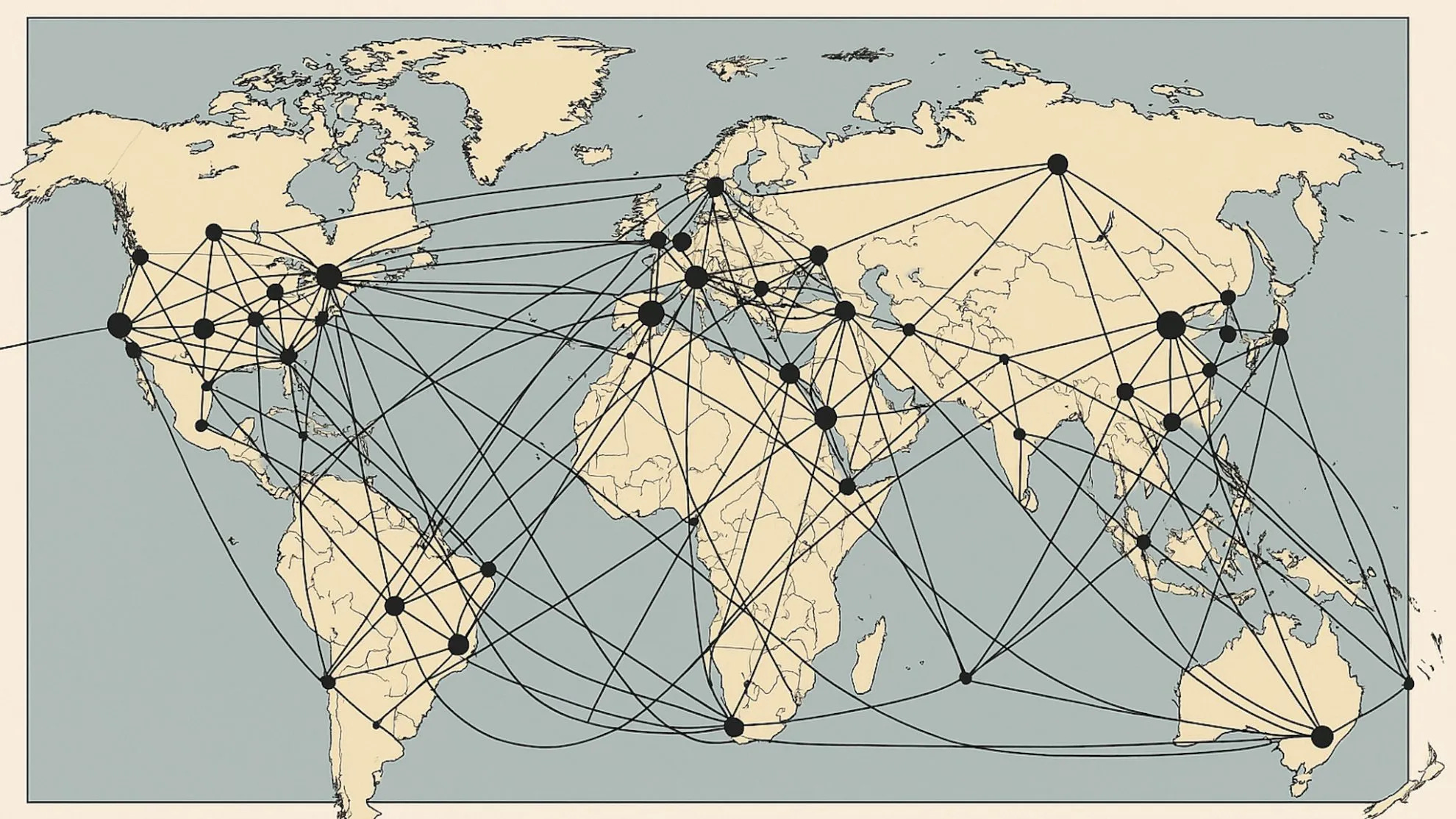
Despite the disturbing parallels and that plausible checklist, several factors still stand between us and Orwell’s world. Some are hard barriers, while others are pure wildcards.
Hard constraints
First, nuclear weapons remain too destructive for anyone to treat nuclear war as truly “limited.” There is no scenario in which a nuke flies and all the rest don’t — this has been wargamed to death. Mutually assured destruction is very much still on the table.
Second, the global economy is far too intertwined. China would collapse without American and European markets, and Western countries would collapse without Chinese goods. In many ways, this was a system intentionally designed to prevent war.
Third, leakage points abound in global power structures: crypto, mesh networks, independent media, and even dissenting elites. Power structures aren’t nearly as monolithic as they seem.
Most importantly, there is no unified “High.” This is the conspiracy theory of all conspiracy theories — that, in fact, no one is actually in charge. This is a controversial statement and I bet I’ll hear feedback on it.
Wildcards
There’s more, too. For example, if young white European men are conscripted and given guns, there’s a decent chance they turn them on their own politicians. In the US, there’s a non-zero chance of a civil conflict breaking out since it’s in its Fourth Turning, and it’s impossible to predict how that’d really go. One thing is sure, however: It would weaken the seed crystal of Oceania.
Taiwan could decide to peacefully join China (I am not recommending that), and Ukraine could finally surrender to Russia. Note the use of hedging language in the previous sentence.
Additionally, we have no idea where this AI ride is going to take us. It could be revolutionary tech that provides sci-fi abundance, it could be a Shoggoth that destroys humanity, it could be a dud, it could lead to economic collapse, or anything in between.
Furthermore, as I’ve argued in another article, cratering birthrates will lead to a proliferation of new belief structures, as mass die-offs always have in the past. These new belief systems will challenge existing structures and lead to new ones.
These forces — structural and chaotic — means the future remains open. For now.
The Blueprint
The seed crystals are visible, with three clear power centers. The wars are already surplus-eating and endless. Information control is far more sophisticated than Orwell imagined, and internal division is doing the Party’s work for it. The checklist to full super-bloc stalemate is disturbingly short, and several boxes could be ticked by accident tomorrow.
We’re emphatically not living in the geopolitics of 1984. But the blueprint has been drawn, it’s sitting on the table, and construction crews are already on shift.
The only question is whether we keep building, or whether the hard constraints, the wildcards, or sheer human unpredictability knock the scaffolding down before the walls go up.
For now, the future remains open.
Sam, I've said it before and I will again. I don't know why your articles don't get more reach.
Im not just saying this to flatter you. I read fairly extensively, and your grasp and analysis is as good or better than many.
I wonder if you're getting algo blocked, or redirected?
Good article m8! I’d like to posit a fundamental inversion of mainstream historical narratives, particularly regarding nuclear doctrine and 1984. The summary of this perspective is as follows:
The official narrative of the 20th century, especially concerning nuclear weapons and Mutually Assured Destruction (MAD), is a sophisticated psychological operation rather than objective history. The “atomic bombings” of Japan are viewed not as military necessities but as geopolitical demonstrations of power by the ones who took the miraculous pictures of the immediate aftermath.
The Cold War's nuclear standoff is interpreted as a managed reality—a perpetual state of fear designed to justify immense government overreach, suppress dissent, and maintain a global power structure. This "balance of terror" is seen as a tool for social control, relying on a population's conditioned fear of annihilation to ensure compliance.
In this context, 1984 is re-evaluated. Rather than being a mere warning from a dissident, it is understood as a potential blueprint crafted by an insider familiar with propaganda techniques. Orwell's background with the BBC's Eastern Service provided him firsthand knowledge of information warfare. The novel's mechanisms—Newspeak, Doublethink, perpetual war, and the manipulation of reality—are not predictions but a codified set of tools for societal control. The elite adopted these methods, using the book as a technical manual while publicly promoting it as a cautionary tale.
The nuclear threat serves as the perfect real-world implementation of Orwell's "perpetual war": an unknowable, existential enemy that justifies permanent emergency powers. Thus, the "nuclear hoax" and 1984are intrinsically linked—the former provides the pretext for the control system, while the latter provides its operational framework. The ultimate conclusion is that we live within a managed reality where the threats used to control us are often fabrications or exaggerations, and the purported warnings against tyranny have instead served as its instruction manuals.