

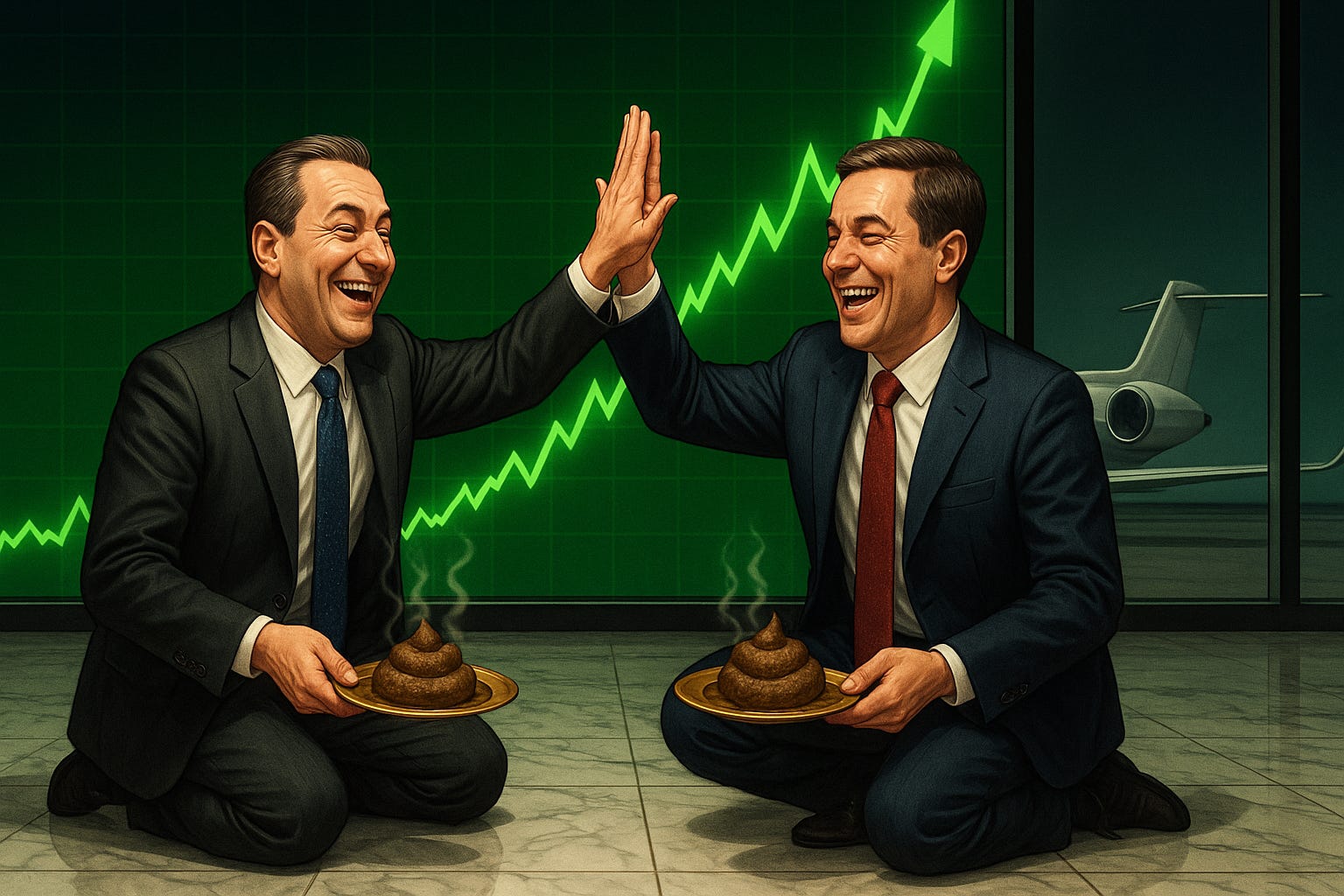
The old joke nails it: Two economists spot a pile of dog shit, pay each other $100 to eat it, and high-five because the GDP just went up $200. That’s Line-Go-Up Economics in a nutshell: mental water aerobics for the morally flexible and terminally credentialed.
I once worked for the US Census. If you trust the official population numbers out of Nigeria, Bangladesh, or Washington, open this early article I wrote in another tab and watch your faith die. If you still believe the numbers, I have bridges for sale, cheap.
But economic data is especially abused. The individual can be broke, the family priced out of the housing market — doesn’t matter. As long as the chart goes up, the priest-class of economists and politicians gets to high-five and buy new private jets.
This is not an accident. Rather, it’s a deflection from a simple reality we all know: Those at the top of the economic system — Epstein’s regulars, Davos headliners, Larry Summers types — really don’t give a damn about you. And they don’t just not care. They have contempt for you.
They’ve been running the same rigged casino for decades, and they’re winning bigly, so why would they stop now? If they ever lose, they just get bailed out, while you get stuck with the bill and some bullshit lecture.
The House We Never Slept In
I’ve got some personal experience with this rigged system. In 1999-2000 during the height of the dot-com bubble, I was a teenager, and my mother was working for a tech company in Austin. It’s one of those companies whose stock went parabolic post-IPO: a 1,500% increase between February 1999 and June 2000, giving it a market cap of $9 billion.
We thought we were rich. My mother had stock in the company, so we bought a house in the nicest part of town. It was perfectly fine as it was, but money does funny things to peoples’ heads, so we decided it had to be remodeled with the best of everything. The most ridiculous and nouveau-riche part was installing columns from a French monastery. We spent more than a year remodeling that house.
Then the dot-com bubble burst, and my mother, with a stock vesting mess on her hands that took a lawyer a year to settle out, got laid off. By the time she got any stock, the price had plunged. We lost around a million bucks in that time. We had to sell the house, not having spent one night in it. Fortunately, we broke even, but the house we had to sell is now worth millions, having rode the wave of Austin real estate prices.
The higher-ups at the company? They made off like bandits. Our potential generational wealth? Gone.
I tell you this as a cautionary tale: Bubbles pop, and when they do, it’s easy to get screwed. It’s even easier if you get greedy. And my goodness, greed is prevalent these days — but it’s nothing new.
The Biggest Party Ever Thrown
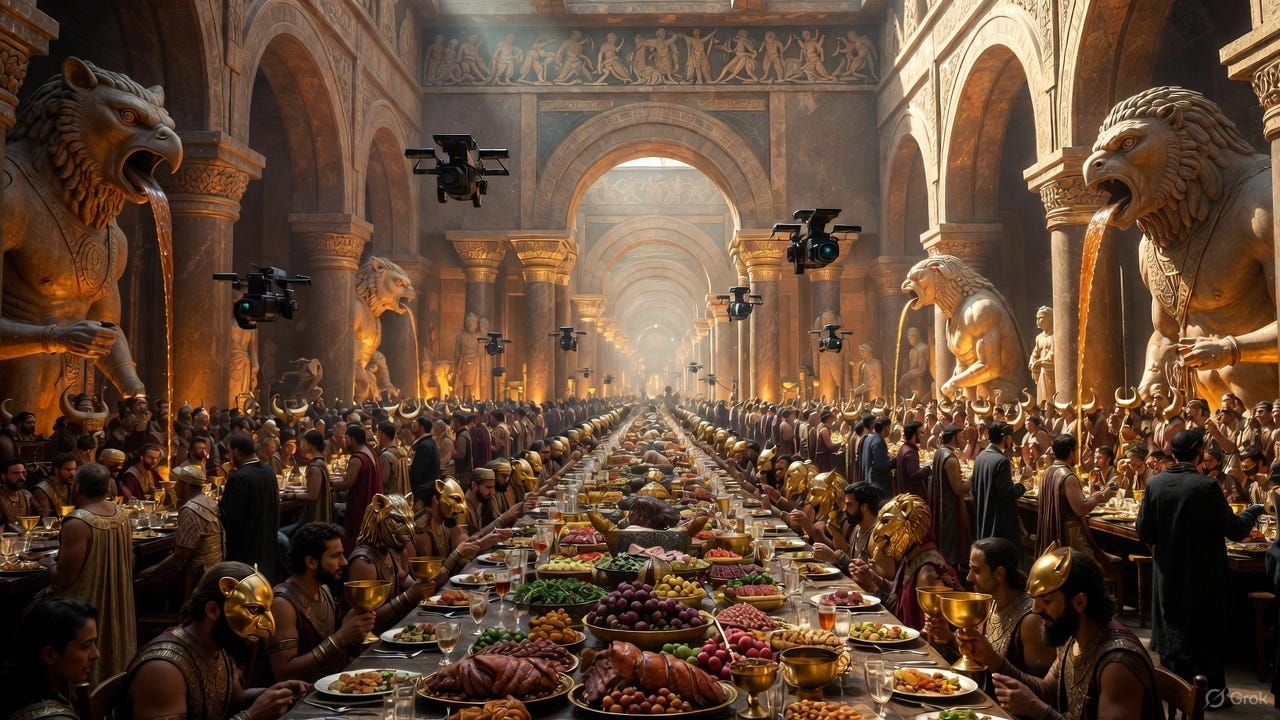
Imagine: Around 2,870 years ago, King Ashurnarsirpal II of Assyria decides to throw the biggest private bash the world’s ever seen. He’s just completed his new palace in Kalhu (Nimrud, northern Iraq). He doesn’t just send out a few engraved invites. No, he invites some 69,574 guests for ten straight days. Tens of thousands of livestock are slaughtered for the occasion, and beer and wine flow like rivers.
It was a rager for the ages, but it wasn’t just to have a good time. It was the OG flex. He built a massive Banquet Stele that read “I spread a feast like a god.” The banquet was designed to demonstrate his power, funded by tribute from crushed enemies and built with slave labor.
The hangovers? Not his problem. The bill? Paid by the people he looted. Sound familiar?
A few centuries later, when Xenophon marched his Ten Thousand past the once-magnificent palaces and cities of Assyria, abandoned and half-buried in sand, not even the local shepherds knew who built them.
Fast forward to now and we’re in the middle of the biggest party ever thrown — except this one’s called the AI boom, and the host is a cabal of trillion-dollar tech lords, Wall Street vampires, and central bankers who’ve been spiking the punch for decades.
Trillions of dollars, fresh-printed by the Fed and shoveled into data centers, GPUs, and “innovation” funds, are fueling a euphoria that makes Ashurnarsirpal’s feast look like a potluck.
Consider: Nvidia — a company that makes fancy graphics cards — has at times been worth more than the entire economy of Germany, the world’s third-largest. Does that sit right with you?
Microsoft and Amazon are snapping up farmland in the middle of nowhere, getting tax breaks you’d never dream of, while your electric bill jumps 40% because their server farms drink more power than Sweden.
The president gets on TV and brags about “the strongest economy ever.” GDP ticks up a couple of points because of all the concrete-pouring and chip-hoarding.
Everyone high-fives, and the line goes up.
But like every great party, the buzz eventually wears off and the hangover kicks in: regret, shame, self-loathing, the creeping realization you did things you can’t undo.
Some guests — the ones who were already rich — wake up fine.
The rest of us get the cleanup bill and a lecture about “living within our means” or some such dreck.
Then the hangover fades, memory blurs, and you have another drink, another line, shoot for another moonshot. Because fuck it, right? You have to live a little.
The dealers know this. So they pour another round, crank the music, and the line goes up again. At least, it will eventually.
The Quiet Panic in the VIP Room
The party hosts are already starting to sweat. White House AI and Crypto Czar David Sacks recently said the following:
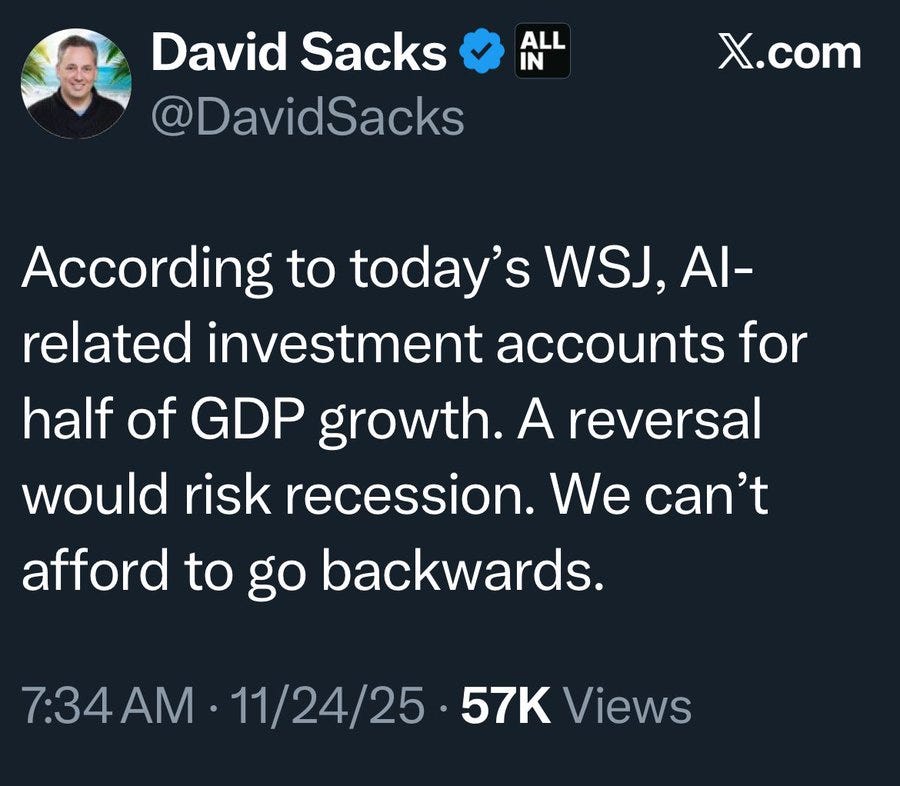
Translation: If the music ever stops, the whole economy goes tits up.
The Financial Times points out similar problems. A recent headline (paywalled) reads, “America is now one big bet on AI.”
That’s basically a hostage video.
Because Nvidia can be worth more than Germany, server farms can drink more power than nations, and the line can keep going up…
Until one quarter the models don’t turn a profit, or a big fund decides to take its chips off the table, or the Fed can’t cut rates any lower because of inflation.
Then the biggest party ever thrown becomes the biggest hangover ever recorded.
That is, unless you believe in the AI dream of permanent abundance. Do you? Drop a comment below if so.
The Cantillon Effect on Rocket Fuel
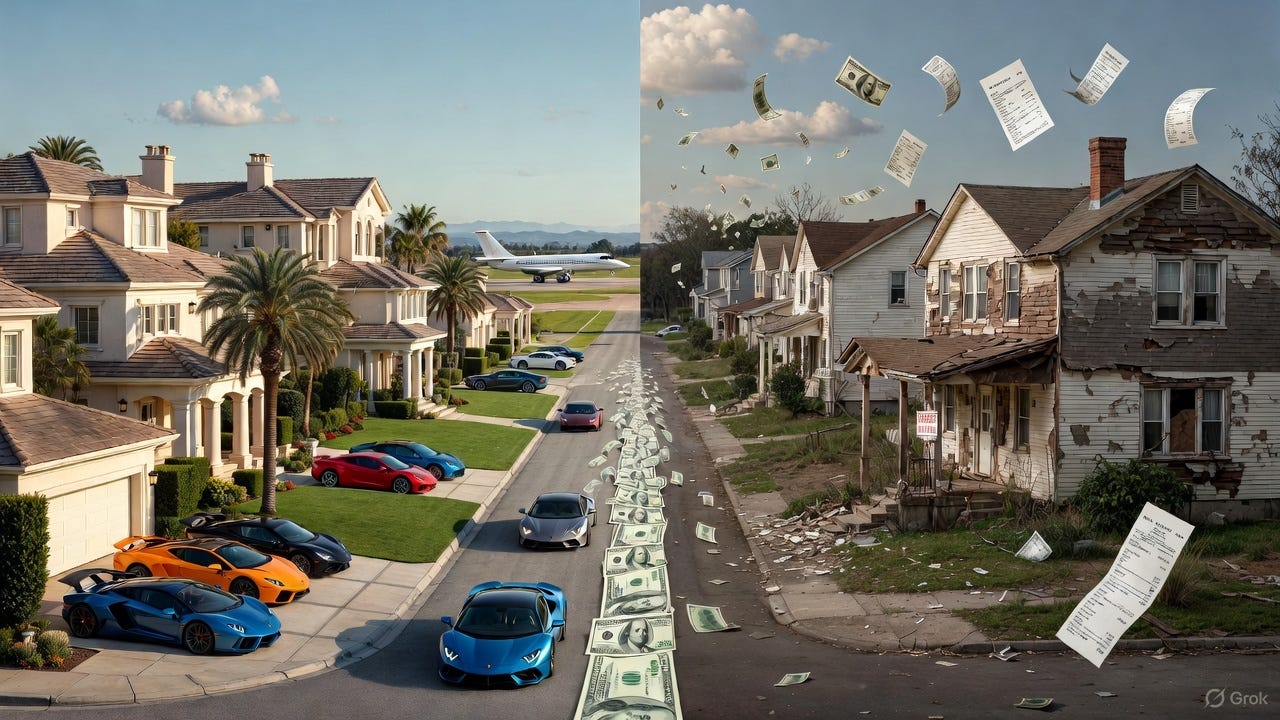
New money never spreads evenly. That truth is officially called the Cantillon Effect, but ordinary people know it as trickle-down-economics not trickling down.
No, the new money lands first, always, with the connected.
In 2025 that means Palo Alto hoodie princes, hedge-fund lords in Greenwich, or Stanford dropouts who wake up billionaires because the right VC wired them nine figures before breakfast.
Larry Summers — the architect of the 2008 bailouts — kept showing up at Epstein’s townhouse and pocketing his money for MIT long after Epstein was a convicted sex offender.
No consequences, same class, same protection, same money firehose.
By the time any of those dollars reach you, they’ve already become what you know too well: higher housing prices, higher rent, higher groceries, higher everything.
Since ChatGPT launched, the top 0.1% vacuumed up three-quarters of the new household wealth while the bottom 80% got poorer in real terms.
They get the champagne and you pick up the bar tab. What a deal!
The Two Futures and the Giant Misdirection
There are only two ways this current run ends.
Their future
The AI bet half-works. The models get good enough to replace half the white-collar jobs, but not good enough for sci-fi abundance.
So the people who own the chips, the data centers, and the power plants end up owning the robots too.
You rent your life in monthly installments: $9.99 for the writing bot, $19.99 for the driving bot, $49.99 for the “don’t-go-crazy” therapy bot, $300/month for the booze-delivery drone for when you do.
UBI slop keeps the herd quiet, the Lolita Express gets rebranded, and the line staggers upward a bit longer.
Our future
The bet fails. One bad quarter of “We’re still not seeing ROI” and the whole house of cards shudders. Data center construction freezes and boom towns bust. Nvidia drops 70%. The “strongest economy ever” looks like Pets.com in 2000 but this time with unpayable debt and a tapped-out Fed. The hangover kicks in and we all wonder, bleary-eyed, how we got so drunk on our own hype again.
Fake wealth evaporates. The line goes down. Capital gets dragged, kicking and screaming, back into steel, soil, and human hands.
The misdirection
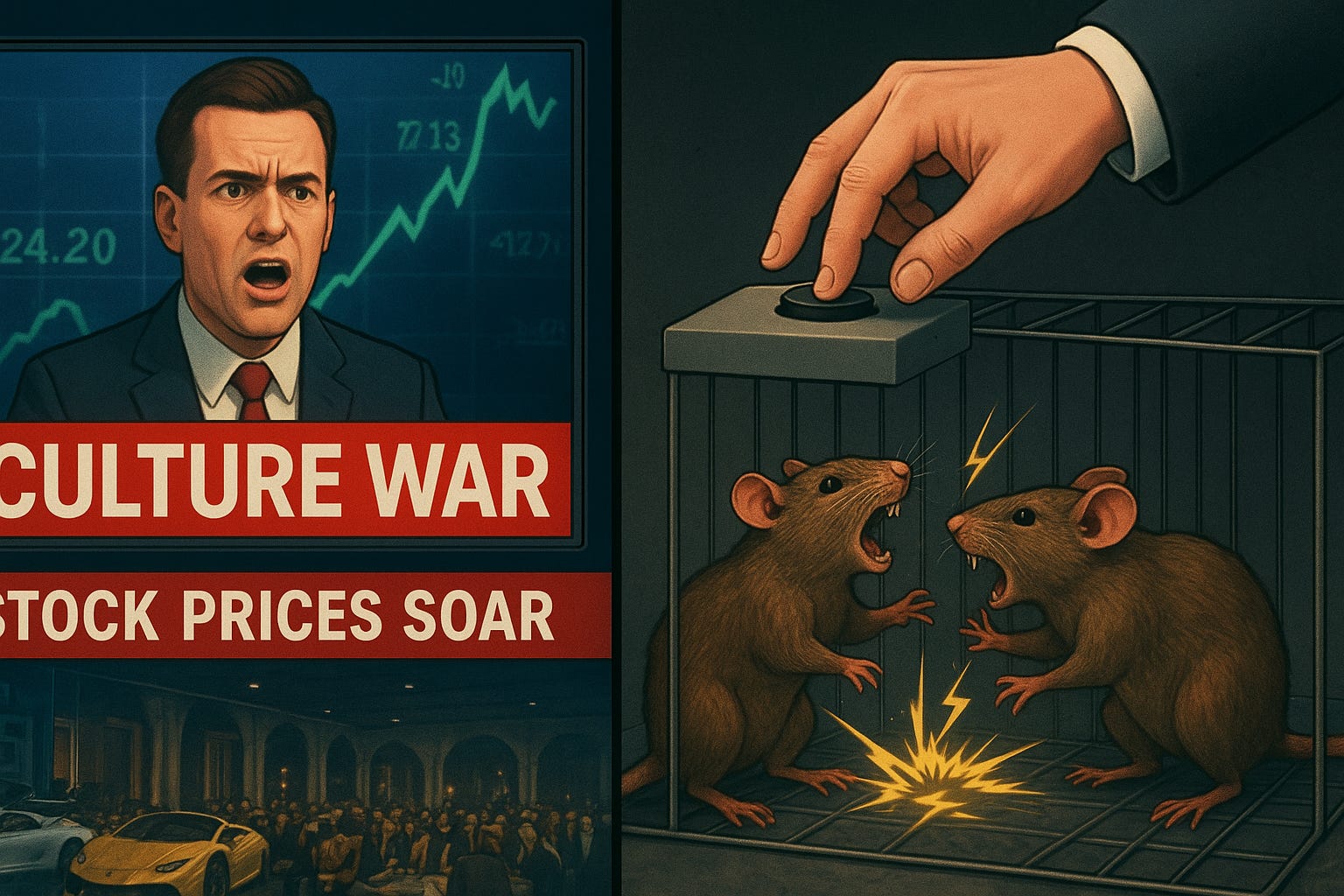
The cracks are already showing. Zohran Mamdani’s win in NYC is about money: rent freezes, free child care, tax the rich. $4,000 rent, maxed-out credit cards, and unpayable student debt hurt worse than ideology.
That’s what both Left and Right elites are hiding. They want you thinking the rage is about culture wars, pronouns, whiteness, guns, January 6th, or whatever else the outrage machine decides to spit out.
The rage is way more simple than that, though: People are angry because they’re poor.
A recent excellent article pointed out a heartbreaking, absurd fact: The Poverty Line, developed as a concept in 1963, is defined as three times the cost of a minimum food diet from back then, adjusted for inflation. Food was way more expensive then, and housing and childcare way cheaper. As the author points out, $100,000 is the new poor.
The Left and Right are both in on the grift, pointing fingers at each other’s phantoms while the Cantillon Casino cashes in. It’s deliberate. It’s intentional: Shock a cage with two rats, and they fight each other, not the finger on the button. This is a proven thing in social mammalian psychology, and the elites know it. Interestingly, rats that are restrained supine are attacked more than those who can defend themselves. Make of that what you will.
When the GOP fails to smash the casino — and they will, because their donors adore it — the rage can turn into wildfire. Sometimes it’ll look like Mamdani populism, sometimes Bolshevism-lite, sometimes neo-fascism.
The only real fault line left to exploit at the top is Israel, which younger people are turning against in record numbers, viewing it as a key symbol of elite rot and corruption. Someone’s going to blow that fault line wide open. Place your bets.
The Final Question
They don’t care about you. They never did. The social contract, that we all get rich together, is broken.
My family learned this with an empty house in 2000. We all learned it again when Epstein “killed himself” and Larry Summers, despite fresh Epstein emails outing more cozy chats, gets little more than a slap on the wrist.
Tolkien nailed the whole thing in The Lord of the Rings in describing the fallen kings of Gondor: “...the blood of Númenor waned in them, and their wisdom failed, and they became as other men, and were childless or of few children, and the glory of Gondor faded.”
Childless, hollow, fertility-collapsed parasites who love money and nothing else. That’s your elite in 2025.
The line was never going up for you. Question is: Do you keep clapping while they cash out — or do you finally stop playing their game?
Great column Sam. 👍🏻